
The Formula 1 Formulas
V6s, V8s, and V10s, oh my

If you’re new to Formula 1, you’ve only known a single ‘era’ of engine configuration. In fact, even if you’ve been watching F1 for a decade, you’ve only known the same single era of engine configuration. While the F1 engines that we listen to haven’t changed in a while, the engine formula of Formula 1 does in fact evolve over time, sometimes quite dramatically.
Here I’ve crafted an approachable breakdown of the various engine eras of Formula 1. Today’s F1 technical regulations are lengthy and receive tweaks of varying magnitude throughout between seasons, sometimes even during the middle of the season. But it’s rare that the sport makes dramatic changes to the type of engines its cars must use. I learned, as a newcomer to the sport nearly ten years ago, that F1 history is often broken up into different ‘eras’ demarcated by the size and specifications of the engine regulations of a given period. But you have to do a fair bit of digging across various websites to learn about the different engine eras. Now, you need not search any further!
The sport’s technical regulations have grown stricter over time which have led to cars that look much more similar to each other than in previous iterations of the regs, for better and for worse. But we’re going to focus on the internals of the car rather than how it looks. Though the cars often do change quite dramatically with each engine era as other aspects of the technical regulations were changed each time the engine regs were updated.
One important primer that I’ll keep brief: An engine is designated by its fluid capacity (called displacement), its shape, and the number of pistons/cylinders it uses. Everyone’s heard of the V8 engine. But if you’ve ever wondered why it’s called a V8, it’s because it uses 8 cylinders which have been arranged in a V-shape. Depending on how big the cylinders actually are, you’ll hear the engine denoted with a fluid capacity number, like 3 liters, or 1.4 liters, or 7 liters, etc. These numbers refer to how much air and fuel fit inside the engine with each stroke of the pistons. The bigger the space inside the cylinders, the bigger the displacement number, and vice versa.
If you’re totally unfamiliar with car engines, I would strongly recommend watching this fun video from Donut Media. It’s a little overwhelming, but a fun illustration of how engines work.
The Original Formula and First Regulations (1950-1966)1
Back in 1950, when the Federation Internationale d’le Automobile held the inaugural season of Formula 1 there were many fewer rules constricting the design of the car. The engine regulations comprised the bulk of the rulebook and were simple enough. You could run either an engine with a capacity of 4.5L so long as it didn’t have a supercharger. If it did, then it couldn’t be any bigger than 1.5L. A supercharger is a mechanical device that captures air as it rushes into the vehicle’s front grille, compresses it, and shoves it into the engine to increase power. They aren’t used in Formula 1 and haven’t been for quite some time, but you can still find them today in some modern muscle cars and pickup trucks, like the Dodge Challenger or Ford F-150.
This era was dominated by the Italians, with Alfa Romeo and then Ferrari winning the championship in each year of this period of technical regulations.
In 1954 the FIA updated the technical regulations to ban supercharging and restrict engine capacity to 2.5 liters. Evidently the Italians aren’t very good at adapting quickly because Mercedes won in 1954 and 1955 quite handily, driven by the legendary Juan Manuel Fangio.
Eventually the Italians came around, with Ferrari and Maserati winning in ‘56, ‘57, and ‘58. But the British finally won their first championships at the tail end of the era, with the Cooper Climax taking home the hardware in 1959 and 1960.
_Solitude_Revival_2019_IMG_1633.jpg)
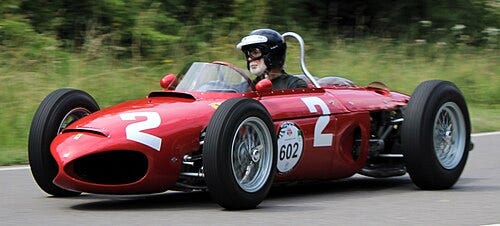
The FIA updated the technical regulations for 1961, lowering engine capacity to 1.5 liters and restricting size to 8 cylinders. This era produced one of my personal favorite F1 cars, the Lotus 25, which won the championship in 1963. This set of regulations was one of the most short-lived, however, as the FIA updated the engine regulations once again, for the 1966 season.
Unlimited Power (1966-1986)
1966 loosened the restrictions for manufacturers, ushering in a true Golden Age of F1 creativity and lunacy. What also made this era interesting is that it was the longest stretch without the FIA changing the engine regulations: 20 years! Cars were allowed to use either a 1.5-liter engine with a supercharger or a 3.0L engine without supercharging. There was one consequential modification to the regulations during this long stretch of time, which I’ll get to shortly.
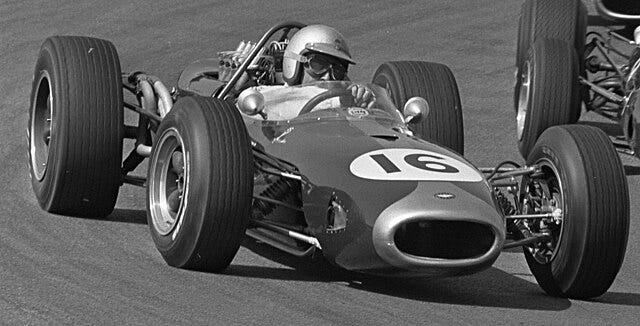
While these are smaller engines than what the sport started with back in 1950, they were cost-efficient and the purposeful stability of the regulations attracted many major manufacturers to the sport, like BMW, Honda, and Renault. Predictable regulations lead to refinement of current technology and ultimately, innovation. Someone ought to tell the President.
From 1966 to 1982, British engine manufacturer Cosworth dominated the sport, powering the championship-winning team 12 times during this 20-years-long era. Cosworth, owned by Ford, never operated a Formula 1 team, but supplied engines to several of them including Lotus, McLaren, Williams, and Brabham. But the Cosworth domination was disrupted in spectacular fashion in the early 1980’s.
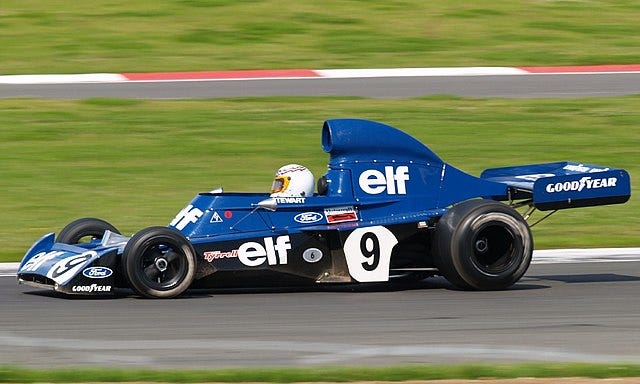
The reason I said things got crazy was because the FIA actually did slightly adjust the regulations during this period. They decided to allow teams to use either a supercharger or a turbocharger alongside the 1.5L engine option. What’s the difference? A turbocharger uses the exhaust gases being produced by the engine to spin a little turbine which compresses air, hence the name “turbo-charged,” and then shoves that compressed air right into the engine, increasing power without having to use more gasoline. Similar in function to a supercharger, but able to produce even more power and an even bigger increase in fuel efficiency than superchargers.
Renault’s F1 team introduced one of these fun little turbo devices in their 1977 F1 car. And I’d love to tell you it was an instant success, but it was essentially a bomb on wheels. It took several years before other teams caught on to the potential of the technology. In fact, the early turbo Renault F1 cars were so unreliable that they were called yellow teapots due to their proclivity to spew white smoke as they broke down.2 It wasn’t until 1979 that Renault would win a race with their turbocharged cars
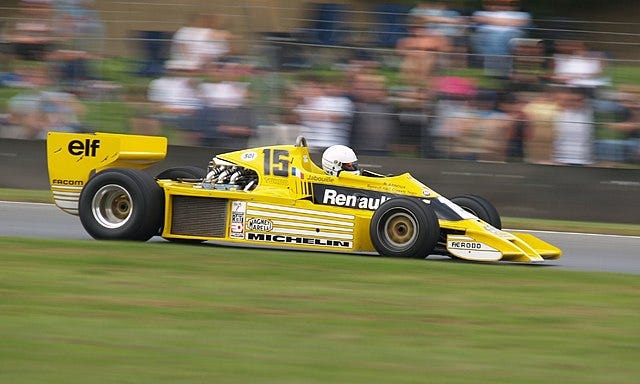
.In the early 1980’s the other manufacturers began to experiment with turbochargers, quickly evolving from skeptical mechanical engineers to Anarchist Cookbook-esque bomb building mad scientists that could not help themselves from giving their cars eye-watering turbo boosts. It was a turbocharger arms race.
The most powerful Formula 1 cars of all time were produced in the mid-1980’s during the turbocharger craze. The 1986 Benetton-BMW B186 is believed to be the most powerful F1 car ever built.3 It appears it was never tested on a dynamometer — a machine which measures horsepower — but BMW claimed to have calculated their engine produced a tectonic 1,500 horsepower. It’s understood that the maximum amount of power was only produced for qualifying sessions and that the team would dial back the turbocharger’s boost pressure for the race. But using that level of power for even just one or two laps during qualifying was so violent that the engine would have to be taken apart and rebuilt following the session, such was the toll of the forces.
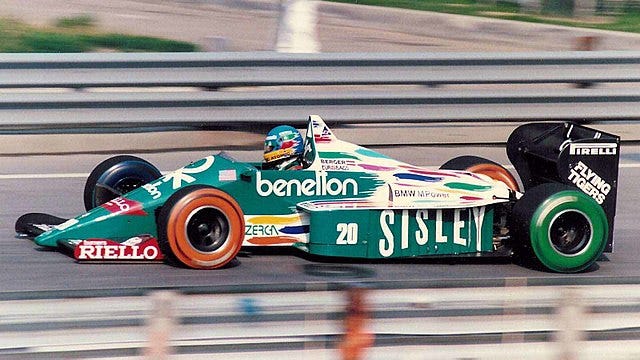
Eventually the FIA decided that the party was over, leading us to the next era of engine regulations.
The Forgotten Era (1987-1988)
For the 1987 season the FIA restricted the size of the turbos that teams could use. Nearly everyone on the 26-car grid were running turbochargers, so it didn’t change too much when the FIA increased the capacity limit for “naturally aspirated” engines (engines sans super/turbocharging) to 3.5L from the previous 3.0L. Even with these changes the differential between turbocharged cars and naturally aspirated cars was still so significant that the FIA created a two-tiered championship, introducing a set of awards for the team and driver operating sans turbo that got the most points. These participation trophies were called the Colin Chapman Trophy and Jim Clark Trophy, named for the mythical man who built Lotus and the revered driver who won championships for Lotus, respectively.
The FIA quickly moved to the next era of engine regulations for the 1989 season, making this formula the shortest-lived of them all.
Screaming into the 90’s (1989-1994)
The 1989 season regulation changes were, on their face, simple. No more turbos, no more superchargers, and engines cannot exceed 3.5L. And, you can have as many cylinders as you like in your engine. However, the apparent simplicity belies the extraordinary results.
The 1980’s were dominated by V6 engines, particularly those produced by Honda, Porsche, and Ferrari. But the loss of turbocharging in 1989 meant that more cylinders would be the easiest way to more powerful engines. So, teams went big. And fans were treated to the greatest racecar noises ever known.
Formula 1 is famous for two things, big money and loud cars. The latter point really became notable in this era of engine regulations as teams opted to run powerful V10 and V12 engines that screamed. From 1989 to 2013, F1 cars were identifiable from miles away by their iconic shriek, causing wineglasses everywhere to shatter.
If you’re at the office and have colleagues sitting around you, I’d encourage you to listen to this video at full volume:
This era laid the groundwork for modern Formula 1. In the early 90’s teams experimented with active suspension, more complex aerodynamics, four-wheel steering, and traction control. These so-called driver aids were banned as they were seen as diminishing the skill required to operate the car. However, while the technology introduced during this period did not stick around for long, the FIA took a much more active role in shaping the cars than they had in previous generations, which lead the sport to the current regulatory environment where the cars are far more standardized.
What was also great about this era was the variety of entrants. There were so many engine manufacturers during this era. I was truly mindblown to see that between 1989-1994 there were a total of 12 engine manufacturers. For reference, since 2014 there have only been 5 engine manufacturers in F1, due to the very high cost of building the modern V6 hybrid power units.
Everyone’s Favorite Era (1995-2005)
I mentioned that the iconic noises of Formula 1 were introduced in the previous era. They were refined and amplified in the 1995-2005 era.
The FIA lowered the engine capacity limit to 3.0L for the 1995 season and mandated that teams must use a V10 from the 2000 season onward (which everyone had already voluntarily switched to by then). Ferrari were the last holdouts, running a V12 engine until the 1996 season.
The 3.0L V10 provided an ideal blend of raw power, reliability, and weight, producing exciting racing and a truly unbelievable soundtrack. It was like listening to a horde of banshees being chased by furious bees, in a good way. For a taste of that, check out this highlight reel from the 1998 Belgian Grand Prix.
The Return of the V8 (2006-2013)
Back in July I wrote that a primary purpose of motorsport is to sell cars, or at least to develop technology that you can put into the cars you plan to sell. Turns out, V10 engines aren’t in high demand from consumers, and the major manufacturers began to balk at the apparent irrelevance to their brands — particularly Toyota and Honda, who had joined the sport in the early 2000’s. So, the FIA introduced the 2.4L V8 requirement in 2006, ushering in a new era that was not initially a huge departure from the previous era.
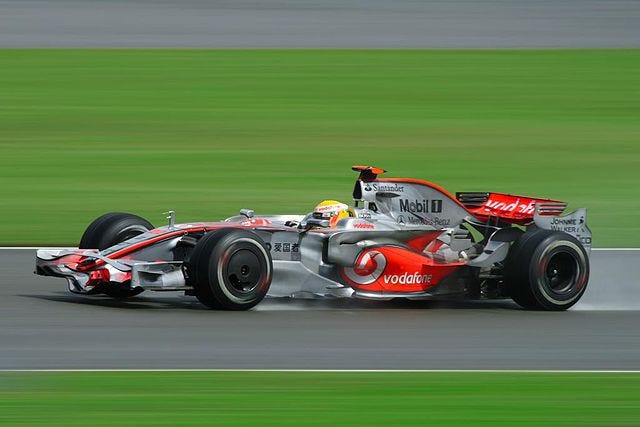
I’m not certain that V8’s sell particularly better than V10’s, particularly for the manufacturers who participated in F1, but it seemed to keep Honda and Toyota in the sport for a couple more years.
The racing was quite good in those years despite the reduction in power, with the championship being decided in close battles routinely. And the introduction of the Kinetic Energy Recovery System (KERS) requirements in 2009 laid the first bricks of the green path to the modern era’s sustainability and road-relevancy focus.
The V8’s still shrieked like angry demons, so that was good too.
The Modern Age (2014-Today)
The FIA introduced the most dramatic regulatory update in the history of F1 for the 2014 season. the 2.4L V8’s were to be swapped for tiny 1.6L V6 engines with hybrid power. Formula 1 had officially gone green!
The loss of the screaming engines was extremely controversial. You don’t have to dig very far into racing forums to find folks who still lament the change from the V10 era, let alone the change from the V8 era. However, the most important metric of any era is the quality of the racing.
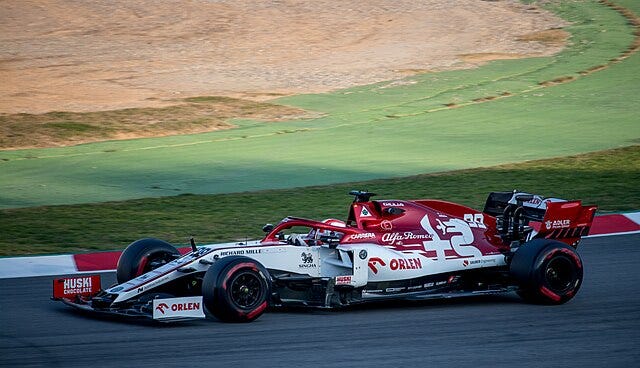
Unfortunately for this era, it hasn’t been great. There have been some good races in the past few years, particularly during the Max Verstappen vs. Lewis Hamilton saga of 2021, but this era of engine regulations has seen domination by one team followed by domination of another team. Mercedes was the only winner of the Constructor’s Championship from 2014 to 2021. It is, and hopefully forever will be, the longest streak of victories in the sport’s history.
Sir Lewis Hamilton, beloved as he may be these days, was winning so frequently that I simply disliked him as a new fan of the sport in 2017. I was tired of hearing him complain about his tires and still win by over twenty seconds basically half the time. Ironically, Red Bull’s domination in 2022 and 2023 was so severe that I was wishing for another Lewis victory. This year in particular I am desperate for Lewis to win for Ferrari; but I’ve gotten off track.
Despite the generally uncompetitive racing, this era has been the Golden Age of Formula 1 purely from a commercial standpoint. It has never been more popular and there have never been as many fans throwing around their money for overpriced McLaren polo shirts. However, today’s popularity has nothing to do with the sustainability push and everything to do with the acquisition of the sport by Liberty Media in 2017 and the subsequent production of Drive to Survive on Netflix.
The current engine regulations are valuable because they have made the sport more like what it was always supposed to be: a spectacle of the most cutting-edge motorsport technology in the world. But the cost of being on the cutting-edge is a significant barrier to entry for new manufacturers and presents a lopsided competition where the moneyed teams (Mercedes, Red Bull, Ferrari, and now McLaren) have enormous advantage over the customer teams who buy their tech since they lack the funds to produce their own. The V6 hybrid power unit alone costs about the same as sending 165 kids to Harvard, and we all know how expensive American college is. So, the FIA is working on ways to make the sport cheaper to enter, and it seems to be working.
The Next Generation (2026-Onward)
The FIA announced its planned updates for the 2026 season. They are fairly substantial and will hopefully have a positive impact on the spectacle of the sport. Already, Cadillac and Audi have announced they’ll be joining the grid in 2026. Audi intends to build their own engine immediately, while Cadillac will be building their own later, likely in 2029.
A chunk of the cost decrease will be due to the removal of the Motor Generator Unit - Heat, which is a very cool but very complicated bit of technology that generates battery power from the heat radiating off the engine. The other major change to the engine regulations is an increased battery capacity, which means the cars are expected to produce half of their power from gasoline and half of it from batteries, whereas it’s currently more like 80% gas, 20% electric. This is obviously a significant change, but it’s not clear exactly how it might affect either the racing or the cost to participate. My guess is it will improve fuel consumption, hopefully leading to more intense racing as drivers won’t have to worry as much about running empty at the end of the race.
Whatever comes next, the certain thing is that F1 will put on a show for us. And if it doesn’t, then the FIA will diligently tweak the engine regulations as they have so many times in the past. Only time will tell.